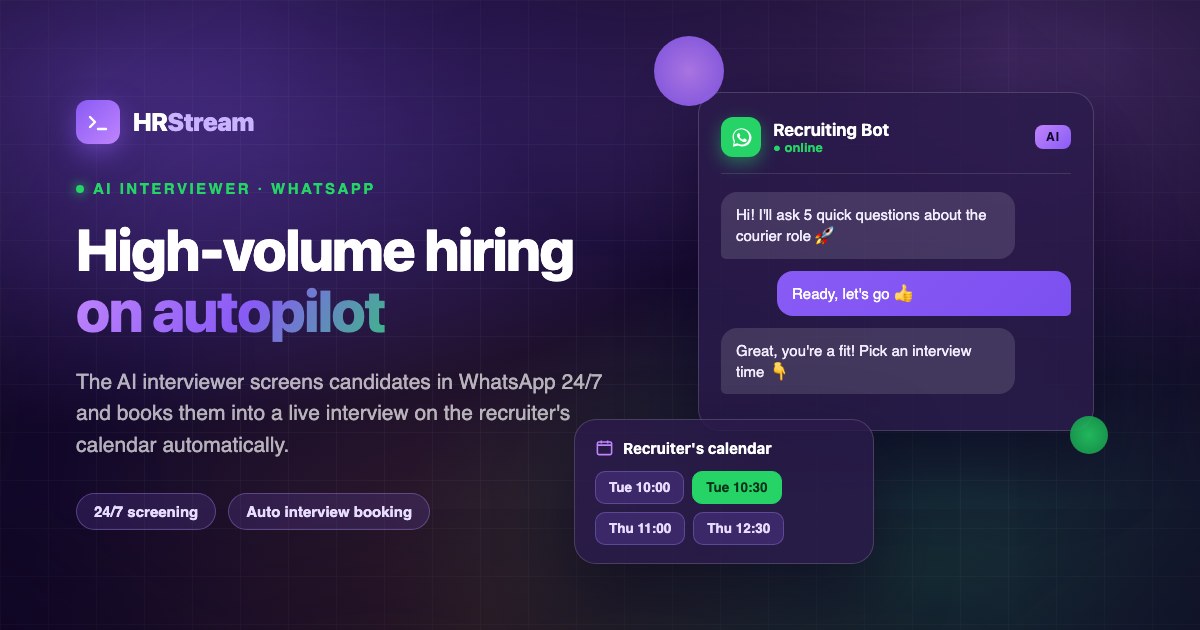
Artificial intelligence is no longer a futuristic concept for HR departments. In 2026, AI tools have become an integral part of the hiring process — from resume screening to conducting initial interviews. In this guide, we'll explore exactly how AI is transforming recruiting, which tools are already delivering results, and how to implement them at your company without pain or chaos.
Why AI in Recruiting Is a Necessity, Not Hype
According to McKinsey research, companies that have integrated AI into their hiring process reduce time-to-hire by 35–50% and cut cost-per-hire by 30%. But it's not just about speed and savings. AI addresses three core recruiting challenges:
- Scale. A single recruiter simply cannot review 500 applications for one role with any real quality. AI can — in minutes.
- Consistency. Humans get tired, get distracted, and carry unconscious biases. AI evaluates every candidate against the same criteria.
- Response speed. Candidates expect instant feedback. 72% of job seekers lose interest if they don't hear back within 48 hours.
5 Areas Where AI Is Already Changing the Game
1. Automated Resume Screening
The traditional approach — a recruiter manually reviewing every resume — is fading fast. Modern AI systems analyze resumes, extract key skills, experience, and qualifications, then rank candidates by relevance to the role.
It's important to understand: good AI screening is not simply keyword matching. It accounts for context, synonyms, adjacent skills, and even a candidate's potential for growth within the role.
"We moved from manually reviewing 300+ applications to automated screening and saved our recruiters 15 hours a week. And the quality of our shortlisting actually improved — we started inviting more relevant candidates to interviews."
— HR Director, logistics company, Almaty
2. AI Chatbots for Initial Candidate Engagement
AI-powered chatbots handle the first point of contact with candidates: answering questions about the role, clarifying key parameters (salary expectations, willingness to relocate, available start date), and conducting an initial screen.
The advantages of AI bots in recruiting:
- Available 24/7 — candidates get a response even at night and on weekends
- Handle dozens of conversations simultaneously
- Collect structured data for the recruiter
- Filter out irrelevant candidates at an early stage
3. Intelligent Sourcing
AI sourcing tools analyze public profiles on LinkedIn, GitHub, and professional communities to build a pipeline of potential candidates. The algorithms don't just search by keywords — they understand career progression patterns and can surface "hidden" candidates who aren't actively job hunting but might be open to the right opportunity.
4. Predictive Analytics
Drawing on historical data, AI forecasts:
- The likelihood that a specific candidate will accept an offer
- The expected time to fill a vacancy
- The risk of a new hire leaving within the first 6 months
- The optimal salary range to attract top candidates
These insights enable more informed decisions and more efficient allocation of recruiting resources.
5. Automation of Routine Tasks
AI takes on the most time-consuming recruiter tasks:
- Scheduling interviews across time zones and availability
- Sending personalized follow-up messages
- Generating hiring funnel reports
- Updating candidate statuses in the ATS
How to Implement AI in Recruiting: A Step-by-Step Plan
Step 1: Audit Your Current Process
Before implementing AI, identify your bottlenecks. Where do your recruiters spend the most time? Which funnel stages have the highest drop-off? How long does it take to close a single vacancy? The answers will show you where AI will deliver the most value.
Step 2: Start with One Process
Don't try to automate everything at once. Choose one process — for example, screening incoming applications — and implement an AI tool for that alone. Measure the results, gather feedback from your team, and only then expand further.
Step 3: Choose the Right Tool
When evaluating an ATS with AI capabilities, pay attention to:
- Integrations. Does the system support your existing candidate sourcing channels (job boards, messengers, social networks)?
- Localization. Does the AI work with Russian and Kazakh? Many Western solutions struggle with Cyrillic text.
- Transparency. Can you understand why the AI made a given decision? A "black box" in hiring is a liability.
- Configurability. Can you tailor the screening criteria to your company's specific industry and needs?
Step 4: Train Your Team
AI is a tool, not a replacement for recruiters. Make sure your team understands how to work with AI recommendations, when to trust the system, and when to apply human judgment. Recruiters must remain at the center of every hiring decision.
Step 5: Monitor and Optimize
Track key metrics after implementation:
- Time-to-hire
- Cost-per-hire
- Quality of hire (assessed at 3–6 months)
- Candidate experience (candidate NPS)
- Conversion rate at each funnel stage
AI and the Kazakhstan Labor Market
Kazakhstan's HR-tech market is growing fast. According to analysts, demand for ATS platforms with AI features grew 40% in 2025–2026 compared to the previous period. Several factors are driving this:
- Rising competition for talent in IT, fintech, and the extractive industries
- Growing application volume through job portals and messengers
- The need for bilingual (Russian + Kazakh) screening
- The push toward digital transformation across public and private organizations
Companies that implement AI in recruiting now gain a competitive edge — they find and hire top candidates faster, while competitors are still manually sorting through stacks of resumes.
Conclusion
AI in recruiting is no longer a question of "if" — it's a question of "when." Companies that delay adoption risk falling behind in the war for talent. Start small, measure results, and scale what works.
If you're looking for an ATS platform with built-in AI screening that works with Russian and Kazakh, integrates with WhatsApp and Kazakhstan's leading job portals — take a look at HRStream. The platform automates recruiting busywork so your team can focus on what truly matters: the people.